
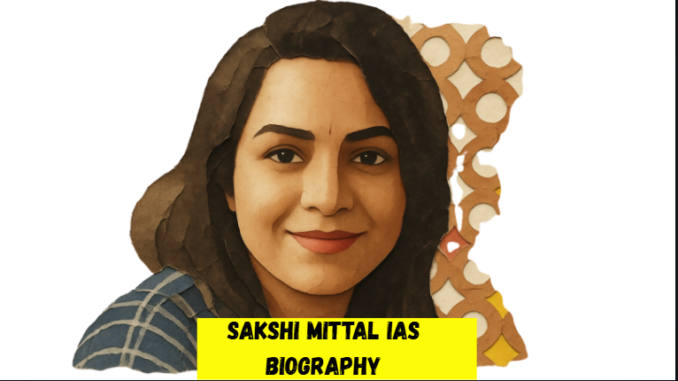
In the vast and often complex machinery of India’s bureaucracy, some individuals stand out not because they seek attention, but because their work quietly shapes decisions that affect millions. Sakshi Mittal is one such officer.
An IAS officer from the AGMUT cadre, she has steadily built a reputation for competence, precision, and policy-driven leadership. From her academic roots in engineering to holding key positions in the Government of India—including her appointment as Joint Secretary—her journey reflects a blend of technical thinking and administrative clarity.
Unlike dramatic, headline-driven stories, Sakshi Mittal’s career is defined by something subtler: consistency. And in governance, that often matters more than spectacle.
In this exclusive article, CheckPoint Media outlines key facts about Sakshi Mittal, including her age, net worth, schooling, husband, and religion.
Sakshi Mittal IAS Biography
| Field | Details |
|---|---|
| Full Name | Sakshi Mittal |
| Age | Around 38 years |
| Nationality | Indian |
| Profession | IAS Officer |
| Cadre | AGMUT (2010 Batch) |
| Current Role | Joint Secretary / Equivalent, Government of India |
| Education | B.Tech (ISM Dhanbad), Graduate (Maitreyi College) |
| Religion | Hindu |
| Marital Status | Married |
| Spouse | Shravin Mittal |
Early Life and Background
Sakshi Mittal’s early life does not come packaged with dramatic anecdotes or widely publicized struggles. And perhaps that in itself is telling.
She belongs to a generation of civil servants who grew up in an India that was rapidly changing—economically, socially, and educationally. Opportunities were expanding, but so was competition.
While specific details about her childhood remain private, her trajectory suggests a disciplined upbringing where education was clearly prioritized. Like many future civil servants, she likely grew up understanding that public service was not just a career option—it was a platform to influence systems.
Academic Foundation
Before stepping into administration, Sakshi Mittal built a strong academic base in science and technology.
She completed her B.Tech from ISM Dhanbad, an institution known for producing technically skilled graduates. Engineering education often trains individuals to think in structured ways—to break down problems, analyze systems, and find workable solutions.
Additionally, her academic association with Maitreyi College reflects a broader educational exposure, possibly contributing to a more balanced worldview.
This combination—technical precision and social awareness—would later become a defining feature of her administrative approach.
Transition from Engineering to Civil Services
Why does someone trained in engineering choose civil services?
The answer often lies beyond career logic. For many, it is about impact.
Sakshi Mittal’s shift from a technical field to public administration suggests a deliberate choice. Engineering can solve problems—but governance decides which problems matter most.
This transition marks the first major turning point in her journey. It reflects a willingness to step into a more uncertain, demanding, but ultimately more influential role.
Entry into the IAS
Sakshi Mittal joined the Indian Administrative Service as part of the 2010 AGMUT cadre—a cadre known for its diversity in postings, covering regions like Delhi, Arunachal Pradesh, Goa, Mizoram, and Union Territories.
AGMUT officers often experience a wide range of administrative challenges early in their careers. From urban governance to remote district administration, the exposure is both demanding and enriching.
For Sakshi, this meant learning to adapt quickly—an essential skill in public administration.
Early Administrative Roles
In the initial years of service, IAS officers typically work at the district level, handling grassroots governance.
While specific postings from her early career are not widely detailed, it is reasonable to understand that this phase would have involved:
- Managing public services
- Coordinating with local administrations
- Handling development programs
- Responding to crises
These years often shape an officer’s administrative instincts. It’s where theory meets reality—and where decisions have immediate consequences.
Key Career Turning Points
Every civil servant’s journey includes moments that redefine their trajectory. For Sakshi Mittal, her transition into central government roles marks one such phase.
Her appointment as Director in the Department of Personnel and Training (DoPT) placed her at the heart of India’s bureaucratic framework. DoPT is not just another department—it plays a crucial role in shaping policies related to civil services themselves.
Working here requires a deep understanding of governance structures, personnel systems, and administrative reforms.
This role likely sharpened her policy-level thinking, moving her from execution to strategy.
Appointment as Joint Secretary
One of the most significant milestones in Sakshi Mittal’s career is her appointment as Joint Secretary (or equivalent) in the Government of India.
This position is not just a promotion—it is a recognition of capability and trust.
Joint Secretaries are responsible for:
- Designing and implementing national policies
- Coordinating between ministries
- Managing large-scale administrative frameworks
It is a role where decisions are less visible to the public but deeply impactful.
Role in Department of Economic Affairs
Her appointment in the Department of Economic Affairs (DEA) under the Ministry of Finance further highlights her evolving role.
DEA is central to India’s economic policy-making. It deals with:
- Economic reforms
- Financial regulations
- Budgetary frameworks
- International financial relations
Working in such a department requires not just administrative skill, but also economic understanding and strategic thinking.
It places Sakshi Mittal in a position where her decisions can influence national-level economic direction.
Leadership Style and Governance Approach
Sakshi Mittal’s leadership style appears to lean toward structured, policy-oriented governance.
With an engineering background, her approach likely emphasizes:
- Clarity in decision-making
- Systematic problem-solving
- Efficiency in implementation
Unlike charismatic leadership that relies on public visibility, her style seems rooted in institutional effectiveness.
In bureaucracy, this kind of leadership often ensures long-term stability rather than short-term recognition.
Influence in Policy Making
Influence in civil services is rarely about public image—it is about shaping outcomes.
Through her roles in DoPT and DEA, Sakshi Mittal contributes to:
- Administrative reforms
- Personnel policies
- Economic governance
These are areas that affect not just government functioning, but also public service delivery at scale.
Her influence, therefore, operates quietly—but significantly.
Personal Life
Sakshi Mittal is married to Shravin Mittal. Beyond this, she maintains a relatively private personal life.
This balance between public responsibility and personal privacy is common among senior civil servants. It allows them to focus on their roles without unnecessary public scrutiny.
There is no widely disclosed information about her children or extended family, reflecting a conscious choice to keep personal matters separate from professional identity.
Public Image and Professional Reputation
Within administrative circles, reputation is built over years—not through headlines, but through decisions.
Sakshi Mittal is seen as a competent and dependable officer. Her steady rise through important roles suggests trust from senior leadership.
In a system where accountability is high and scrutiny constant, such a reputation is not easily earned.
Net Worth and Financial Standing
Sakshi Mittal’s net worth is not publicly confirmed.
Like most civil servants, her primary source of income is her government salary and associated benefits. Civil service careers are typically not defined by wealth accumulation, but by stability and public responsibility.
Broader Significance of Her Career
Why does Sakshi Mittal’s journey matter?
Because it reflects a larger truth about governance in India: not all impact is visible.
Behind every policy, every reform, and every administrative decision, there are individuals working quietly, often without recognition.
Her career represents that invisible backbone of governance—the system that keeps functioning, evolving, and responding.
Conclusion
Sakshi Mittal’s story may not be dramatic, but it is deeply instructive.
It shows that influence does not always require visibility. That leadership can be calm, measured, and precise. And that in a country as vast as India, real change often comes from those who work behind the scenes.
In many ways, her journey is like the wiring inside a building—you don’t see it, but without it, nothing works.
FAQs
1. Who is Sakshi Mittal IAS?
Sakshi Mittal is a 2010-batch IAS officer from the AGMUT cadre, currently serving in a senior role in the Government of India.
2. What is Sakshi Mittal’s current position?
She has been appointed as Joint Secretary or holds an equivalent role, including work in the Department of Economic Affairs.
3. What is her educational background?
She holds a B.Tech degree from ISM Dhanbad and has also studied at Maitreyi College.
4. Who is Sakshi Mittal’s husband?
She is married to Shravin Mittal.
5. What is known about her net worth?
Her net worth is not publicly disclosed and is primarily based on her government service career.
Leave a Reply