
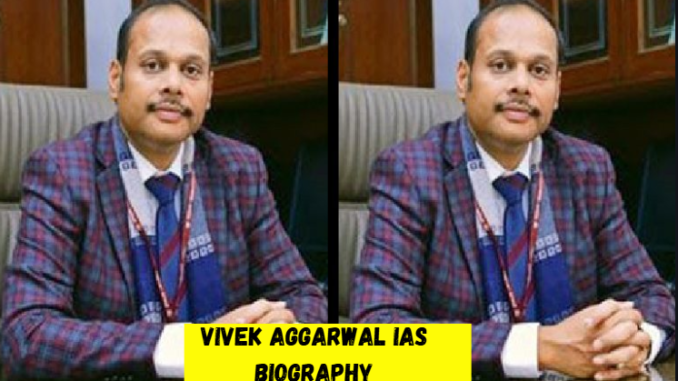
In India’s vast administrative machinery, some officers become widely known for public-facing decisions, while others quietly shape policies that influence millions. Vivek Aggarwal belongs to the latter group—a senior civil servant whose career reflects depth, discipline, and a steady climb through some of the most critical corridors of governance.
Unlike headline-driven bureaucrats, Aggarwal’s work has largely unfolded behind the scenes—within ministries, financial systems, and policy frameworks that keep the country running. His journey offers a compelling look at what it means to build influence not through noise, but through sustained, thoughtful contribution.
CheckPoint brings forward a carefully written article outlining Vivek Aggarwal’s age, financial status, education, spouse, and faith.
Vivek Aggarwal IAS Biography
| Field | Details |
|---|---|
| Full Name | Vivek Aggarwal |
| Year of Birth | 1971 |
| Age | 55 (as of 2026) |
| Nationality | Indian |
| Profession | IAS Officer |
| Cadre | Madhya Pradesh |
| Batch | 1994 |
| Education | B.Com, LL.B |
| Current Role | Secretary, Ministry of Culture |
| Languages | English, Hindi, Punjabi |
Early Life and Background
Vivek Aggarwal’s early life reflects a familiar yet powerful Indian narrative—one rooted in education, discipline, and an awareness of public systems.
Born in 1971, he grew up in an environment where education was not just encouraged but expected. While detailed public accounts of his childhood remain limited, what becomes evident through his career is a strong grounding in structure and responsibility.
His formative years likely coincided with a period of economic and political transition in India. Growing up during these shifts may have shaped his understanding of governance—not as an abstract idea, but as something that directly impacts livelihoods.
Academic Foundations
Aggarwal’s educational choices reveal an interesting combination: commerce and law.
He completed a Bachelor of Commerce and later pursued an LL.B. from Panjab University, Chandigarh. This dual background is more than academic—it’s strategic.
- Commerce provides insight into financial systems
- Law builds understanding of regulatory frameworks
Together, they form a toolkit that is particularly valuable in public administration.
He also pursued professional training through the Institute of Company Secretaries of India (CS Inter) and attended a course at the London School of Economics on globalization and international financial systems.
That exposure to global thinking adds an important layer. It suggests a mindset that doesn’t just operate within India’s systems but understands how they connect to the wider world.
Choosing Civil Services
Why does someone with a strong background in commerce and law choose the IAS?
Because civil services offer something unique: scale.
In the private sector, decisions may impact a company. In the IAS, decisions can shape entire regions.
Aggarwal’s entry into civil services appears driven by this broader vision—the ability to engage with complex systems and influence policy at multiple levels.
Entry into IAS
As part of the 1994 batch of the Indian Administrative Service, Aggarwal joined the Madhya Pradesh cadre.
The early years of an IAS officer’s career are often spent in field postings—learning governance at the ground level. These roles are where theory meets reality.
For Aggarwal, this phase would have been crucial in understanding the everyday challenges faced by citizens—from infrastructure gaps to administrative bottlenecks.
Early Career and Field Roles
Like many IAS officers, Aggarwal began with district-level responsibilities, including roles such as District Collector.
These positions are often described as the backbone of Indian administration. Here, officers deal directly with public issues—law and order, development programs, and crisis management.
Such experiences tend to leave a lasting imprint. They shape not just administrative skills but also empathy—an often overlooked aspect of governance.
Rise Through Administrative Ranks
Aggarwal’s career progression reflects consistency rather than sudden leaps.
Over the years, he held several significant roles across:
- Government of Madhya Pradesh
- Government of Punjab
- Government of India
He served in capacities such as Principal Secretary, Managing Director, and Commissioner—positions that require both administrative control and policy insight.
Each role added a layer to his experience, gradually moving him from field administration to policy-making at higher levels.
Key Roles in Government of India
One of the defining phases of Aggarwal’s career has been his work at the central government level.
He served as:
- Additional Secretary, Department of Agriculture and Farmers Welfare
- Joint Secretary in the same department
These roles are critical in a country where agriculture remains a key sector. Policy decisions here directly affect millions of farmers.
Later, he moved to the Department of Revenue, Ministry of Finance, where he served as Additional Secretary.
This transition—from agriculture to finance—highlights his versatility. Few officers navigate such diverse domains effectively.
Leadership in Financial Governance
Perhaps one of his most sensitive roles was serving as Director of the Financial Intelligence Unit (FIU-IND).
This position deals with monitoring financial transactions, preventing money laundering, and ensuring compliance with financial regulations.
Think of it as working behind the scenes to keep the financial system clean and secure.
Such roles demand discretion, analytical thinking, and a strong ethical framework—qualities that define long-term credibility in public service.
Secretary, Ministry of Culture
In April 2025, Vivek Aggarwal was appointed as Secretary to the Government of India in the Ministry of Culture.
At first glance, culture may seem less complex than finance or agriculture. But in reality, it’s deeply layered.
Culture involves:
- Heritage preservation
- Promotion of arts
- Management of historical institutions
- Balancing tradition with modernization
Aggarwal’s appointment to this role signals trust in his ability to handle diverse and sensitive portfolios.
Administrative Style and Influence
If one had to describe Aggarwal’s leadership style, it would likely be:
- Measured rather than impulsive
- Analytical rather than reactive
- Policy-driven rather than personality-driven
He represents a category of bureaucrats who prioritize systems over visibility.
In a world increasingly drawn to loud leadership, his approach feels almost understated—yet effective.
Contribution to Public Policy
Aggarwal’s contributions are not always visible in headlines, but they are embedded in systems.
His work across agriculture, finance, and governance has likely influenced:
- Policy formulation
- Implementation frameworks
- Institutional efficiency
This is the kind of impact that doesn’t trend on social media but shapes long-term outcomes.
Personal Life
Vivek Aggarwal maintains a low public profile when it comes to his personal life.
He is known to be fluent in English, Hindi, and Punjabi, reflecting his diverse professional exposure.
Like many senior civil servants, he appears to keep a clear boundary between public responsibilities and private life—a choice that often helps maintain focus in demanding roles.
Net Worth and Financial Standing
There is no widely verified public data confirming Vivek Aggarwal’s exact net worth.
As a career civil servant, his income is primarily derived from government salary and official allowances. While some estimates circulate online, they should be treated cautiously unless supported by credible disclosures.
Conclusion
Vivek Aggarwal’s career is a reminder that influence doesn’t always come with visibility.
He has worked across some of the most important sectors in government—agriculture, finance, and now culture—quietly shaping systems that affect millions.
In many ways, his journey reflects the ideal of civil service: steady, structured, and rooted in responsibility.
He may not always be in the spotlight, but his work ensures that the spotlight functions as it should.
FAQs
1. Who is Vivek Aggarwal IAS?
Vivek Aggarwal is a senior IAS officer of the 1994 batch from the Madhya Pradesh cadre, currently serving as Secretary in the Ministry of Culture.
2. What is Vivek Aggarwal’s educational background?
He holds a B.Com and LL.B. from Panjab University and has also studied international financial systems at the London School of Economics.
3. What are his key career roles?
He has served in agriculture, finance, and financial intelligence roles, including Additional Secretary and Director of FIU-IND.
4. What is his current position?
As of 2025, he is the Secretary to the Government of India in the Ministry of Culture.
5. Is Vivek Aggarwal’s net worth publicly known?
No, there is no officially confirmed information about his net worth; his earnings primarily come from government service.
Leave a Reply