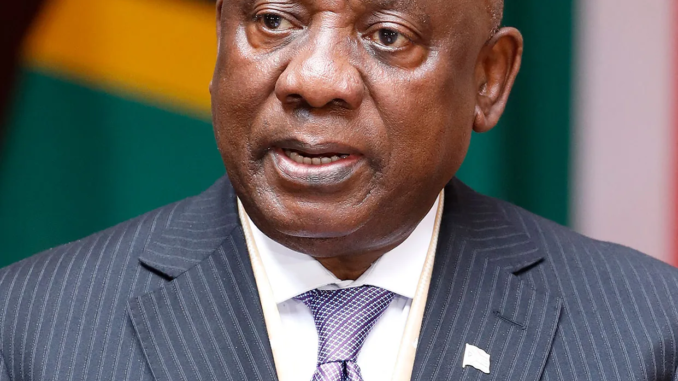
Few political careers in Africa can match the sheer range and drama of Cyril Ramaphosa’s journey. He has been a trade union firebrand, a key negotiator in dismantling apartheid, a business titan worth billions, and finally, the President of the Republic of South Africa. His life reads less like a conventional political biography and more like a case study in persistence, reinvention, and the complicated terrain of post-apartheid South African society.
Matamela Cyril Ramaphosa was born on November 17, 1952, in Soweto, Johannesburg — a name that, to the world, became synonymous with the resistance against apartheid. He grew up in a country where the color of your skin determined everything: where you could live, what education you could access, and what your future could hold. That Ramaphosa rose from those conditions to the presidency is a testament to both his individual talent and the remarkable generation of South Africans who refused to accept the world as it was handed to them.
Cyril Ramaphosa Biography

| Full Name | Matamela Cyril Ramaphosa |
|---|---|
| Date of Birth | November 17, 1952 |
| Age | 71 years old (as of 2024) |
| Nationality | South African |
| Ethnicity | Venda |
| Religion | Christianity |
| Occupation | President of South Africa, Businessman, Former Trade Unionist |
| Spouse | Dr. Tshepo Motsepe (current wife) |
| Known For | ANC Secretary-General, COSATU leader, Constitutional negotiator, President of SA |
Early Life and Background
Cyril Ramaphosa was born into a Venda family in Soweto. His father, Samuel Ramaphosa, was a police officer — a position that carried social complexity in apartheid South Africa, where Black police officers were often caught between loyalty to the state and the community they served. His mother, Erdmuth, raised him in a household that, despite limited means, valued education and community engagement.
He attended high school at Mphaphuli High School in Sibasa, in the Venda homeland — now part of Limpopo province — where he began developing his political consciousness. The inequality and oppression he witnessed daily were not abstractions; they were daily realities that shaped his thinking. By the time he arrived at the University of the North (now University of Limpopo) to study law, he was already politically active.
His activism at university led to his first detention by apartheid security forces in 1974, under the Terrorism Act. He was held for eleven months without trial — an experience that hardened rather than deterred his commitment to the liberation struggle. A second detention followed in 1976, in the wake of the Soweto uprising. These were formative experiences that put Ramaphosa on the security apparatus’s radar and cemented his identity as a resistance figure.
Education
Ramaphosa studied law at the University of the North and later at the University of South Africa (UNISA). He qualified as an attorney, though his legal practice was largely eclipsed by his union and political work. His legal training proved invaluable in later years, particularly during the constitutional negotiations of the early 1990s, where precision of language and structural thinking were essential skills.
Career Journey
In the early 1980s, Ramaphosa helped found the National Union of Mineworkers (NUM) and served as its Secretary-General. The NUM became one of the most powerful labor unions in South Africa’s history, representing hundreds of thousands of Black mineworkers who had long been exploited and marginalized by a mining industry that generated enormous wealth — none of which trickled down to those doing the most dangerous work.
His leadership of the NUM gave him a national profile and demonstrated qualities that would define his career: the ability to negotiate from a position of moral clarity, the patience to sit across the table from opponents and find common ground, and the organizational discipline to build durable institutions.
When the ANC was unbanned in 1990 and Nelson Mandela was released from prison, Ramaphosa emerged as one of the leading figures in the negotiations to dismantle apartheid. He served as the ANC’s chief negotiator in the multiparty talks that produced the interim constitution of 1993 and the framework for South Africa’s first democratic elections in 1994. His counterpart in those negotiations was Roelf Meyer of the National Party — and the two men’s working relationship became a symbol of what was possible when political opponents genuinely committed to finding a peaceful resolution.
After 1994, Ramaphosa made what many saw as a surprising pivot: he stepped away from frontline politics and entered the business world. He became one of South Africa’s most successful Black businessmen through black economic empowerment (BEE) transactions, accumulating stakes in mining, fast food (including a stake in McDonald’s South Africa), and various other sectors. His Shanduka Group became one of the most prominent BEE investment vehicles in the country. By the 2000s, he was a billionaire — one of the wealthiest Black South Africans in history.
He returned to active politics in 2012, when he was elected Deputy President of the ANC, and became Deputy President of South Africa in 2014 under Jacob Zuma. In December 2017, in one of the most closely contested ANC leadership elections in decades, Ramaphosa defeated Nkosazana Dlamini-Zuma to become ANC President. In February 2018, following Zuma’s resignation, he was sworn in as President of the Republic of South Africa.
Presidency and Leadership
His presidency has been defined by the dual challenge of institutional reform and economic recovery. He came to power on an anti-corruption platform, promising to clean up the state capture wreckage left by the Zuma administration. Progress has been made — the Special Investigating Unit and the National Prosecuting Authority have been reinvigorated — but critics argue the pace has been insufficient and that vested interests within the ANC continue to resist accountability.
His handling of the COVID-19 pandemic in 2020, including South Africa’s early lockdowns, drew international praise for its decisive early action, even as the economic consequences were severe. He was re-elected as ANC President in 2022 and continues to serve as head of state.
Personal Life
Ramaphosa has been married three times. His current wife is Dr. Tshepo Motsepe, sister of billionaire businessman Patrice Motsepe, whom he married in 1996. He has children from his previous relationships, and the family maintains a relatively private profile. He is also known for his passion for game farming and the breeding of Ankole cattle, a long-horned breed for which he has paid record prices at auction — an interest that has occasionally attracted controversy given South Africa’s persistent inequality.
Net Worth
Ramaphosa is one of South Africa’s wealthiest individuals. His net worth, accumulated through BEE investments and business ventures, is estimated in the range of hundreds of millions of US dollars, though precise figures are not publicly confirmed. Since assuming the presidency, his active business roles have been placed in blind trusts to manage potential conflicts of interest.
Legacy
Cyril Ramaphosa’s legacy remains a work in progress. He is a man whose biography spans apartheid resistance, democratic negotiation, billionaire capitalism, and presidential governance — each chapter raising different questions about power, principle, and what it means to lead in post-apartheid South Africa. His defenders see in him a pragmatic, patient architect of a better future. His critics see a man who has too often chosen caution over courage. The truth, as with most significant public figures, likely lives somewhere between those two poles.
Frequently Asked Questions
What ethnic group does Cyril Ramaphosa belong to?
Ramaphosa is of Venda ethnicity, from the Limpopo region of South Africa.
What was Cyril Ramaphosa’s role before becoming president?
He served as Deputy President of South Africa under Jacob Zuma (2014–2018) and was a leading trade unionist and constitutional negotiator before entering business.
Who is Cyril Ramaphosa married to?
He is currently married to Dr. Tshepo Motsepe, whom he wed in 1996.
What is the Shanduka Group?
Shanduka Group was Ramaphosa’s private investment company, one of the most prominent Black Economic Empowerment (BEE) vehicles in South Africa, before he divested his interests upon returning to frontline politics.
When did Ramaphosa become President of South Africa?
He was sworn in as President of South Africa on February 15, 2018, following Jacob Zuma’s resignation.
Leave a Reply