
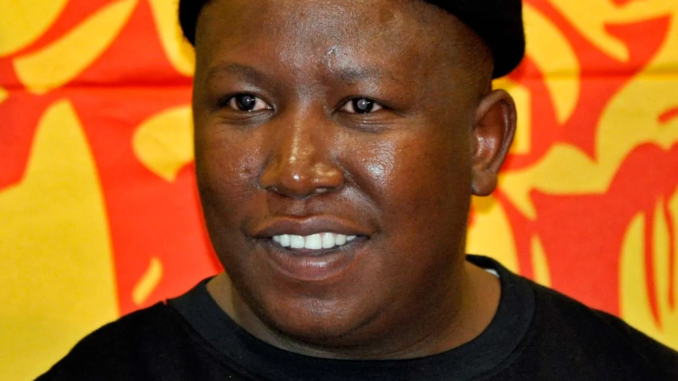
Julius Sello Malema does not do moderation. In a political landscape where many leaders carefully calibrate their language to avoid giving offence, Malema has built an entire career on the opposite principle. He is loud, provocative, unrepentant, and frequently ahead of the mainstream conversation on issues that other politicians prefer to avoid — particularly land reform, economic inequality, and racial justice in post-apartheid South Africa.
His admirers see in him the raw, unfiltered voice of South Africa’s poor and dispossessed — a leader who says what the ruling class does not want to hear. His critics see a demagogue whose rhetoric is dangerously incendiary and whose personal financial conduct has raised serious questions about integrity. Both assessments contain elements of truth, and that tension is precisely what makes Malema one of the most significant and complicated political figures in contemporary Africa.
Julius Malema Biography
| Full Name | Julius Sello Malema |
|---|---|
| Date of Birth | March 3, 1981 |
| Age | 43 years old (as of 2024) |
| Nationality | South African |
| Ethnicity | Pedi (Northern Sotho) |
| Religion | Christian |
| Occupation | Politician, Member of Parliament |
| Spouse | Mantwa Matlala (married 2014) |
| Children | 2 |
| Known For | Economic Freedom Fighters (EFF) founder; former ANC Youth League President; land expropriation advocacy |
Early Life and Background
Julius Malema was born on March 3, 1981, in Seshego, a township outside Polokwane in Limpopo province, South Africa. He is of Pedi (Northern Sotho) heritage, and his upbringing in a Limpopo township gave him firsthand experience of poverty and inequality. His mother, Florence Malema, was a domestic worker — a fact he references regularly in political speeches as he draws connections between the personal and the structural.
He was raised largely without his father, and has spoken about his mother’s sacrifices in ensuring he attended school and remained engaged with his community. His political consciousness developed very early — he joined the ANC Youth League while still at school, and by his teenage years was already a committed and increasingly prominent activist within that structure.
Education
Malema attended Mohlakaneng High School in Seshego, where his political activities became as important as his academic work. He later enrolled at the Limpopo School of Government and Public Administration (now part of the University of Limpopo), studying governance. However, he did not complete his degree — a fact that has been raised by critics as relevant to his qualifications for political leadership. He has acknowledged the incomplete degree while pointing to his practical political education as sufficient preparation for his role.
Career and Political Journey
Malema rose rapidly through the ANC Youth League, becoming its President in 2008. In that role, he was one of the most vocal supporters of Jacob Zuma during the factional battles that consumed the ANC in the mid-2000s. His political profile grew enormously — he was controversial, media-savvy, and capable of mobilizing young South Africans in ways that the established ANC leadership both valued and feared.
The relationship with the ANC deteriorated badly. His increasingly radical rhetoric — particularly on land expropriation without compensation, nationalization of mines, and what he described as the ANC government’s failure to deliver on the promises of liberation — put him on a collision course with the party leadership. He was expelled from the ANC in 2012 after a disciplinary process that his supporters characterized as political persecution.
In 2013, he founded the Economic Freedom Fighters (EFF), a radical left-wing political party that entered the South African Parliament in 2014’s general elections with 6.35% of the vote — a remarkable result for a brand-new party. The EFF’s distinctive red overalls and hard hats, worn by members in Parliament, were an immediate visual statement: this party represents workers and the poor, not boardrooms.
In Parliament, the EFF has been the most disruptive — and some would argue most effective — opposition force in South Africa’s democratic era. EFF MPs have consistently challenged the ANC government on corruption, service delivery failures, and economic inequality with a directness and persistence that other opposition parties have not matched. Their interventions in parliamentary debates have frequently gone viral and shifted national conversations in ways that more genteel opposition politics had failed to do.
By the 2024 elections, the EFF had established itself as South Africa’s third largest party, though it faced increasing competition from other opposition forces. Malema remains the party’s Commander-in-Chief — a title that reflects both his military-inflected organisational culture and his dominant personal authority within the EFF.
Controversies
Malema’s career has been accompanied by persistent controversy. He has faced legal proceedings related to money laundering and corruption allegations connected to government contracts in Limpopo during his ANCYL years, though these cases have moved slowly through South Africa’s court system. His personal lifestyle — including his Sandton residence and luxury goods — has been cited by critics as inconsistent with his rhetoric about economic justice for the poor.
His public statements have also generated controversy: comments about farm invasions, references to historical conflicts, and the EFF’s “Kill the Boer” song have drawn accusations of inciting racial violence from some quarters, accusations he and the EFF have consistently and forcefully rejected.
Personal Life
Julius Malema married Mantwa Matlala in 2014. The couple have children together. He has spoken about his family life as a source of grounding and stability separate from the turbulence of his public role. He has a strong personal following that extends beyond formal politics — his social media engagement, particularly on X (formerly Twitter), is among the most followed of any South African politician.
Net Worth
Malema’s personal net worth is a subject of ongoing speculation and legal scrutiny. He has denied accumulating wealth improperly. Precise figures are not publicly confirmed. His parliamentary salary and income from EFF leadership constitute his disclosed income; allegations of undisclosed wealth remain matters before South African legal authorities.
Legacy
Whatever one’s political assessment of Julius Malema, his impact on South African political discourse is undeniable. He forced conversations about land, inequality, and the limits of the post-apartheid settlement onto the national agenda at a time when the ANC government preferred to downplay them. He has given political voice to millions of young, poor Black South Africans who felt unrepresented by the established parties. Whether that voice is deployed responsibly, constructively, and with the required degree of personal integrity is the central question that history will eventually answer.
Frequently Asked Questions
What party did Julius Malema found?
He founded the Economic Freedom Fighters (EFF) in 2013, after being expelled from the ANC. The EFF entered Parliament in 2014 and has since become South Africa’s third largest political party.
What ethnicity is Julius Malema?
He is of Pedi (Northern Sotho) ethnicity, from Seshego in Limpopo province, South Africa.
Who is Julius Malema’s wife?
He married Mantwa Matlala in 2014. They have children together.
Was Julius Malema ever part of the ANC?
Yes. He was the President of the ANC Youth League from 2008 until his expulsion from the ANC in 2012, following disciplinary proceedings related to his public statements and conduct.
What is the EFF’s main political position?
The Economic Freedom Fighters advocate for land expropriation without compensation, nationalization of mines and banks, free education and healthcare, and the broader redistribution of South Africa’s wealth along radical left economic lines.
Leave a Reply